Thursday, March 31, 2016

by Leighton Gage

If you come to visit us in Brazil, you’ll occasionally see a stand where the offerings look like this:


Literatura de Cordel (lit. “cord literature”) derives its name from the way the wares are often displayed, i.e. hung by a cord, usually with the aid of clothespins.


Such stands are less common in the southern part of the country, but are a feature in many of the fairs and markets of the northeast, principally in the States of Pernambuco, Paraiba and Ceará.
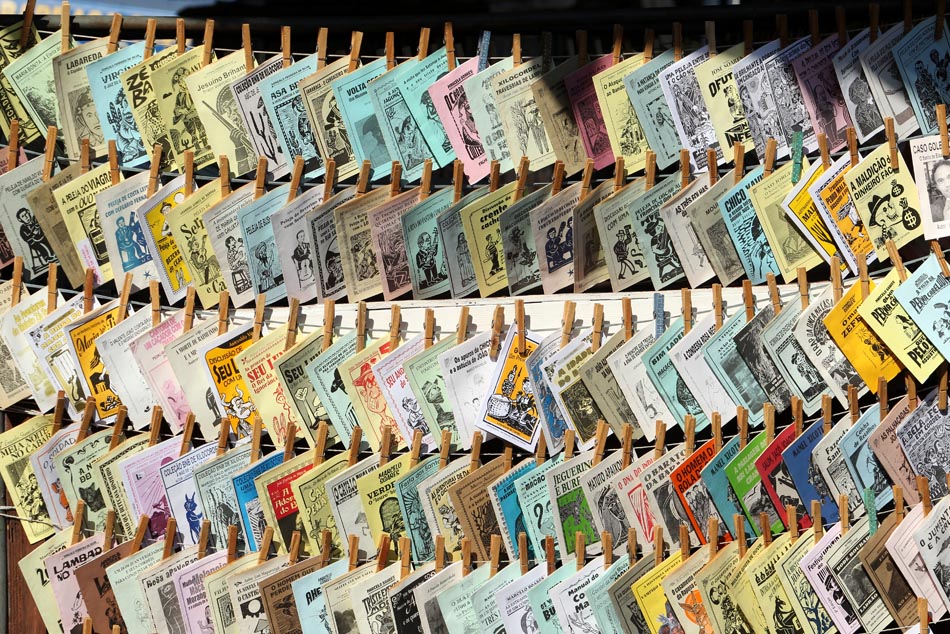

These little booklets are the last survivors of a form of popular literature with which an inhabitant of eighteenth-century Madrid, or nineteenth-century England, would have been quite familiar, but that you’d be hard-put to find elsewhere in the modern world. They contain stories and ballads and are generally produced in black-and-white, illustrated with woodcuts.

Down through the years, the content has taken-on a distinctly Brazilian flavor.


Many of the books deal with the folklore, legends and history of the northeast, subjects like Lampião and his band.

I've previously written about him under the title The Bandit King. And, if you like, you can read that post by going here:


One of the classics of cord literature, The Arrival of Lampião in Hell, by José Pacheco, is much-prized by collectors.


And a satire on the Brazil’s former president, The Arrival of Lula in Hell has enjoyed a good deal of success.

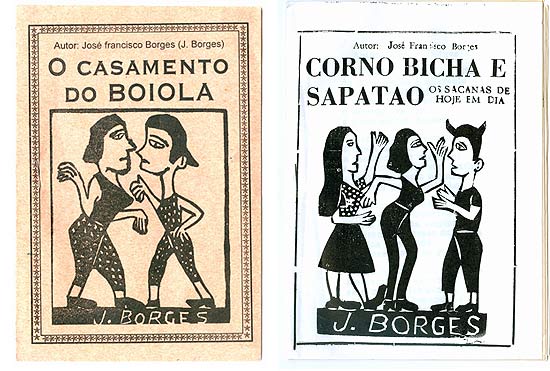
As to the art, two of the more talented woodcutters are Adir Botelho and José Francisco Borges.

This is Botelho:


And this is a work from Borges, who has had expositions at both the Louvre and the Smithsonian:


Monday, February 29, 2016

Make Every Word Count


One of my early writing instructors stressed the need to make every word count. He said each word needs to pull its own weight and every unnecessary word should be culled from the plot. Good advice that I've followed over the years, although, coupled with my journalism training, I'm sometimes too brief, leaving out desirable descriptions.

I've found that writers need to engage readers, not simply enlighten and entertain them. Creating strong word images that readers can relate to is preferable to forcing them to fill in the blanks. For example, a military Hummer conveys a much stronger image than having a protagonist ride to the rescue in a Volkswagen bug. Sue Grafton's Kinsey Millhone was a notable exception..

Strong verbs are necessary to give one’s plot a dynamic, energetic tone. Words such as hurried, leaped and flew as opposed to passive words like walked fast, made his way or became airborne. And as we’ve all been told, stay away from the verb to be in all its forms because it’s the weakest of words. But I confess that I still use all forms of to be in dialogue. Some rules are made to be broken, often at your own risk.

Adverbs that end in –ly also weaken a writer's prose. Use them sparingly. On the other hand, strong specific verbs give writing vitality. I’m reminded of my interview with A.B. Guthrie, Jr. who said, “The adjective is the enemy of the noun and the adverb is the enemy of damn near everything else. Writers use too many descriptive words." As for adjectives, author Lois J. Peterson once said, “One well-chosen adjective can be more effective than two or more, which used together might weaken the idea or image.” I agree.

Do we really need adverbs? Not unless it's impossible to come up with strong verbs. Eliminate the adverbs in a second draft and replace them with muscular verbs. As for adjectives, the rundown house can be rewritten as a hovel or shack. A good reason for every writer to have access to a thesaurus, including an electronic one.

Word choices affect the plot’s pace. If every symphony movement maintained the same pace, the audience would fall asleep before the finale. So writers need to think of themselves as conductors, controlling the pace with word choices, syntax and variety. Long sentences and paragraphs slow the pace and seem introspective while short, choppy sentences are much more dramatic and conducive to action scenes. So, in order to keep someone reading, sentences and paragraphs should vary in length.

Sentence rhythm is important, so reading one's work aloud before committing it to a final draft can prevent clumsy sentence structure. Some word choices bring a sentence to an abrupt halt and should be rewritten or replaced, along with all unnecessary words. The musical analogy is a good one (not my own) because sentence flow is so important.

Thursday, February 4, 2016

Plotting Your Mystery

A strong opening sentence is obviously the best way to pull your reader into the story:

~Today is the last day of my life.

~The body was hanging at eye level.

~ The snow was so deep that only his cap was visible.

I know that you can write better opening sentences to entice your reader into your fictional world. It’s a writer’s job to seduce and lure, one carefully crafted step at a time into an adventure away from reality.

The reader needs to know where you’re taking her and why. Is your fictional world believable? Fantasy writers can get away with great stretches of the imagination but mystery writers need to stick to the facts. So don’t have a body suspended in mid-air unless you have a logical reason to do so.

Your opening sentence should lead directly into your main theme. Don’t start with a couple kissing on a park bench unless one or both are shot or witness to a nearby killing. And don’t start with boring backstory or you’ll soon lose your reader. Jump immediately into the action. Keep your reader breathless for pages before you let him up for air.

Motivation and goals are essential in developing your plot. Another good way to lose your reader is to have your protagonist risk his life simply because he had his foot stepped on. If the killer murdered the character’s mother, you have a believable reason for him to go after the culprit. Some amateur sleuth stories border on the ridiculous when ordinary people decide to trap a killer simply because they think they can. Give them good reasons to place their own lives in danger.

Don’t people your plots with too many characters. Mark Twain wrote that the best way to get rid of characters when they’re no longer needed is to have them jump down a well. Better yet, make sure characters are only there to further the plot and can be eliminated when you tie up all the story’s loose ends.

Killing off characters can be painful for the writer but extraneous side plots can kill a story. In the old western films cowboys rode off into the sunset with the townspeople staring after them. Not so with mystery novels, no matter what the sub genre. We want to leave the reader wanting more. Readers like to solve the mystery on their own before the conclusion, so don’t make the killer’s identity the most unlikely candidate in your plot. Be fair when you plant red herrings and clues so that the reader will be able say, “Aha, I should have known it was him (or her).”

What’s the best opening sentence you’ve written or read?

Tuesday, January 19, 2016

Writing for Older Readers


I write senior sleuth novels because there’s a growing market for retirees who enjoy  reading about characters in their own age group. I was intrigued years ago by Miss Marple and Hercule Poirot, who were wise and introspective, but never seemed to have any fun.

That’s not true of today’s seniors who are less inclined to retire to their rocking chairs than previous generations.

The late Pat Browning, who wrote Absinthe of Malice, said: “A St. Martin's editor gave me a piece of advice I have never forgotten: ‘Be careful not to turn your characters into cartoons.’ I try to picture older characters as they are--the same people they always were, only older. This is especially true when it comes to romance and sex. For all the jokes about senior sex, it's a very real part of senior life, and it's no joke to those lucky enough to have a romantic partner late in life.”

I agree. Not unlike Janet Evanovich’s character, Grandma Mazur, who is eccentric enough for a cartoon character, most seniors have the same interests they’ve always had, with the possible exception of roller blading and downhill skiing. On second thought, I once interviewed Buffalo Bill’s grandson Bill Cody, who learned to downhill ski at 65 to keep up with his much younger wife.

Mike Befeler writes what he calls “Geezer-lit.” His novels feature his octogenarian protagonist, “who is short on memory but has a sense of humor and love of life. He accepts his ‘geezerhood,’ solves a mystery and enjoys romance along the way.”

My second senior sleuth mystery, A Village Shattered, takes place in a California retirement village. The plot is generously sprinkled with humor but none of the seniors resemble cartoon characters, although a couple come close with a redneck Casanova and love starved widow. Diary of Murder followed and I portrayed the two 60-year-old protagonist widows as quite capable of traveling the country in their motorhome as well as chasing down killers who happened to be drug dealers. 

Another senior writer, Beth Solheim, spent years working in a nursing home and says she loves the elderly and their “humorous, quirky insight to life, love and longevity.”

Chester Campbell, an octogenarian, writes the Greg McKenzie Mysteries. He said, “My friends in this [age] bracket are out going places and doing things. Some, like me, continue to work at jobs they enjoy. I chose to use a senior couple in my books who are long married, get along fine, and do a competent job as private investigators. Greg, who narrates the books, is aware of his limitations from age and makes up for physical shortcomings by outsmarting his adversaries. My hope is to dispel some of the absurdity of the stereotypes about seniors that are all too familiar. Like the old song says, "Anything you can do I can do better."

Like so many other novelists, I write what I enjoy reading. My readers are mainly retirees and baby boomers who number over 78 million. Some 8,000 boomers are moving into the senior column every day, the fastest growing potential book buying market on record.

We’re experiencing the graying of America. What better subgenre to write about?

Friday, January 1, 2016

Happy New Year!

January First has traditionally been a day of renewal and promises to oneself to do better in the coming year, so resolutions are made and usually kept for a few days to perhaps an entire month before we fall back into our old ways.

The top resolutions are usually the following: 

Weight loss: Losing weight comprises the most resolutions for Americans. Over a third of the population resolves to exercise more and stay healthy. A weight loss program is easy to start but if you don't find one you can live with, you'll fall off the wagon before the wheels gather dust. Nutritionists say to eat less and switch to healthier food such as the Mediterranean diet.  It's not easy to give up junk food, especially sugar laden sweets. But with determination and some basic tips you can slowly develop healthier eating habits. Learn to control emotional eating, be aware of reasons why diets fail, and research healthy recipes.

Improving  concentration and mental skills: There are plenty of supplements on the market that claim to make you smarter, but do they really work? Experts say that most improve memory although they don't actually raise your I.Q.  Some meditation techniques such as TM (Transcendental Meditation) are known to recharge one's batteries, and reading a good book instead of watching mind-numbing TV programs has been proven to help prevent frontal brain shrinkage and dementia. Cross word puzzles and other mind games are also good sources of improving concentration and mental skills.

Improving social skills:  When we stay at home and don't make the effort to meet people, we  miss out on opportunities to make new friends and enjoy life more. Networking can improve one's well-being and career, so we  need to overcome shyness, acquire knowledge as well met interesting people. 

Gaining confident and taking chances: If you're confident, others notice and are more likely to listen to what you have to say, so bone up on subjects that interest others, including current events. Make sure you're knowledgeable when you express your opinions. A good dose of self-confidence will help you lead a much happier life.

Earn more money: Even the wealthy search for ways to earn more money, and those of us climbing the financial ladder can always use an additional source of income to make life more enjoyable. Fortunately there are options available, such as a second job, taking employment courses, freelancing or using the Internet to your advantage.

Become more Tactful: Good manners have always been important although they don't seem to be practiced as much by the younger generations. Politeness makes it easier to connect with others, avoid offending people and ensures that others perceive you as a good and trustworthy person. So learn etiquette and deal with rude people the right way, as well as learning how to say no without offending.

Reducing stress: Stress kills and it can ruin relationships as well as your health. Stress may be an unavoidable side effect of modern life, but it can be effectively managed with the help of a good stress management course.

Happier with life: Even those who are in good physical shape, earn a decent living and have stress under control can be unhappy. Happiness requires time and patience to learn how to find joy in small things and prevent problems from getting you down. The right partner can also contribute to a happier life.

More sleep  It can be difficult to get sufficient sleep with a TV in the bedroom as well as computers, smart phones, tablets and gadgets with glowing lights and beeping alarms. We need 7-8 of sleep to function well enough to get through the day, and avoiding electronic devises in the bedroom is a good start. Avoiding sweets before bedtime is also a good practice.

Other traditional resolutions are to stop smoking, stop drinking or doing drugs, control one's temper, become more loving and kind to others, and stop beating yourself up over trivial matters. Whatever your resolutions happen to be, I wish you more self-discipline and self-control in the coming year as well as successes and happiness.
Happy New Year!!!

Tuesday, December 15, 2015

Christmas Around the World


by Jean Henry Mead

While researching Christmas customs around the world, I discovered that the first Christmas tree was decorated in 1510 in Germany and Livonia (now Estonia and Latvia). And in many countries Santa Claus is known as Father Christmas. In Latvia he places gifts under the tree and a special dinner is prepared of brown peas with bacon sauce, small pies, sausages and cabbage.

In Finland, where children believe that Father Christmas lives above the Arctic Circle, they call him Korvatunturi. Their three holy days include Christmas Eve, Christmas Day and Boxing Day (a public holiday in many countries known as the second day of Christmas). Finnish people eat rice porridge and a sweet soup of dried fruits on Christmas Eve, then decorate a spruce tree in their homes. A "Christmas declaration" is broadcast throughout the country at mid-day via radio and television. And that evening a traditional Christmas dinner is served consisting of casseroles containing liver, rutabaga, potatoes and carrots with ham or turkey as well as various salads, sweet and spiced breads and cheeses. They also attend church and decorate the graves of their departed relatives. Children receive their presents on Christmas Eve from someone in the family dressed as Father Christmas.

In Hungary the Winter Grandfather (Santa Claus) arrives on the sixth of December when children place their carefully cleaned shoes outside the door or window before retiring for the night. The following morning they find candy and small toys in red bags placed inside their shoes. Youngsters who don't behave find a golden birch branch next to their shoes, which is meant for spanking, although it's rarely used. On Christmas Eve, children visit relatives or attend movies while baby Jesus delivers Christmas trees and presents to their homes. Candy and other edibles are hung on the tree as well as glass balls, candles and sparklers. Fresh fish with rice or potatoes and pastries are usually served that evening for dinner, after which the children are allowed to see their decorated tree for the first time. Christmas songs are then sung and gifts opened. Older children usually attend Christmas mass with their parents later that night and on Christmas Day the kids are allowed to eat the sweets hanging from their tree.

In Belgium Sinterklays (St. Nicholas) is also celebrated on December 6, and is observed separately from the Christmas holiday. Santa Claus is known as Kerstman or le Pere Noel because there are three languages spoken within the country—Dutch, French and German. Santa Claus brings gifts to the children on Christmas day and small presents for family members are placed beneath the tree or in stockings hung near the fireplace. Sweet breads called cougnour or cougnoleand and shaped like the baby Jesus are eaten at breakfast.

Romanian children receive small gifts on December 6 from St. Nicholas in their freshly-polished shoes. Rural families "sacrifice”a pig on December 20, and each part of the pig is cooked in a different way, such as sausage or mince meat cooked with rice, onions and spices. They also dress up as bears and goats to sing traditional songs at each house in the village. Children visit other homes, not unlike our Halloween, to sing carols and receive sweets, fruit or money. Transylvanians serve stuffed cabbage on Christmas Eve and eat the leftovers for lunch the following day when they return from church services.

Brazilians call Father Christmas Papai Noel and the date of celebration differs in various regions of the country. Christmas trees are decorated by even the poor who have plastic trees or simple branches decorated with cotton to represent snow. Christmas dinners for the affluent usually consist of chicken, turkey, pork or ham served with rice, beans and fruit, often served with beer. The poor usually have chicken, rice and beans with  beer or colas. For desert they enjoy brigadeiro made of chocolate and condensed milk.

Christmas is called Noel in France and Father Christmas is known as Pere Noel. Christmas dinner is an important family gathering with the best of meats and finest wines. Christmas trees are often decorated with red ribbons and white candles, and electric lights adorn fir trees in the yard. Most people send New Year’s cards instead of at Christmas to wish friends luck, and Christmas lunch is celebrated with fois gras, a strong pate made of goose liver followed by a meal of seafood.

House windows are decorated in Germany with electric candles and color photographs as well as wreathes of leaves with candles called adventskrant, which signal the arrival of the four-weeks before Christmas. Additional candles are added as the holiday grows nearer. Father Christmas, called Der Wihnactsmann, delivers presents to the children during the late afternoon of Christmas Eve after celebrants return from church. A member of the family rings a bell to announce that presents are under the tree. Christmas Day is celebrated with a meal of carp or goose.

Father Christmas delivers gifts to Portuguese children on Christmas Eve. Gifts are left under the tree or in their shoes near the fireplace. Christmas dinner usually consists of dry cod fish and boiled potatoes at midnight.

During the reign of the Soviet Union, Christmas celebrations were prohibited. The New Year was celebrated instead when Father Frost brought gifts to the children. Now in Russia, Christmas is celebrated on December 25, or more often on January 7, the date the Russian Orthodox church reserves for religious observances. Christmas dinner consists of cakes, pies and meat dumplings.

New Zealanders celebrate by opening presents under the tree on Christmas morning. They then have Christmas lunch at home or a family member's house. A dinner of chicken or turkey is eaten, followed by tea time and dinner cooked on the barbie, served with beer or wine. And in Sweden, a special dinner is served on Christmas Eve of ham, herring and brown beans. Many attend church early on Christmas Day before gathering to exchange gifts with family members.

Christmas customs in this country are too numerous to list, and I'd like to wish all our blog visitors a very Merry Christmas and a happy and prosperous New Year, no matter where you happen to live, or how you plan to celebrate the holiday.

Tuesday, December 8, 2015

Converting Blog Articles into a Book


I never dreamed of converting interviews from my Mysterious People blog into a book when I established the site in 2008. But such good advice and life stories evolved that I couldn’t allow the material to disappear into cyber space. I recycled a great many interviews and decided to make them available to all Amazon.com readers.

Before the interviews were accepted for publication by Poisoned Pen Press, I submitted them to three publishers, all of whom accepted, so I was faced with a dilemma. Do I go with PPP, which only offered to publish a Kindle version or two small, well respected presses, which offered a print version but wanted to make changes. I finally decided to accept Poisoned Pen’s contract with the hope they would also publish a print edition or sell the print rights to another publisher. Eventually they released a large print edition (shown above),

Interviews with unknown writers usually don't sell books and I found the best time to approach a bestselling author is just before a new release, which is probably why Sue Grafton agreed to an interview when V is for Vengeance was released. Embolded from acceptances from Elmore Leonard, Lawrence Block,Carolyn Hart,  Nancy Pickard, J.A. Jance and other publishing giants, I asked Janet Evanovich for an interview. So far I haven’t received an answer, but you can’t win them all.

I’ve featured quotes from interviewees on one of my Facebook pages. Among my favorites is one from Nancy Means Wright: "Vermont writer Howard Frank Mosher nails up rejection slips and adverse reviews on the side of his barn and shoots holes in them. I just leave mine in a cardboard box and let my Maine Coon cats make a nest or pee on them. So send that manuscript out again!"

And from Louise Penny: "Finish the book. Most people who start books never finish them. Don't be one of those. Do it, for God's sake. You have nothing to fear--it won't kill you. It won't even bite you. This is your dream--this is your chance. You sure don't want to be lying on your death bed regretting that you didn't finish the book." Lawrence Block was more succinct with his advice: "Write to please yourself. And don't expect too much."

I've had so many good interviews since Mysterious Writers was accepted that I published another, The Mystery Writers. I began my writing career a news reporter so interviewing is second nature. And the rewards are immeasurable.

I hope aspiring writers will discover something in these collections to help them in their struggle to publication, which is the main reason for the blog site as well as these books. Mystery readers also enjoy reading about their favorite authors.