Sunday, June 26, 2016


by Marja McGraw

Jean asked me what inspired the personalities in the book, and this is the short version.

One of my favorite authors, Dorothy Bodoin, and I discussed that we’d both like to try our skills on a time travel book. Further inspired by two songs, Time in a Bottle by Jim Croce, and That Sunday, That Summer as sung by Natalie Cole, I took a step out in faith. I could do this, or at least I’d try my best to write a time travel story.

I thought about people I know and how they might react to life if they lived in another time period; specifically, 1909. Honestly, I have no idea what led me to choose that year. I remembered older people I’ve known throughout my life. They loved to share stories about growing up in an earlier era. Somehow it all came together.

The main character in Choosing One Moment is Carrie McFerrin. I had to give her a lot of thought and determined she must be a mystery writer whose skills someone wanted to put to use. There had to be a purpose for her time travel. Is she based on me? Not at all. Well, she is a bit clumsy, and that’s a trait we share.

She traveled to 1909 as the request of her great-aunt Genny, who’d traveled before her. I might add that Carrie didn’t travel willingly. Genny reminds me a bit of my own aunt.

My husband inspired more than one character because of the many sides to his personality (the good guys). Inspired is the key word. The world needs good men, and he was one of them.


The book includes an aged woman called Mother Possum. When I was a child there was a woman in her nineties who was called Mother Possum, and I’ve never forgotten her. The name alone made her fodder for a character. And, yes, her surname was actually Possum.

I could go through character by character, but that would be too time-consuming. In my other mysteries, the people are purely fictional, for the most part. I can’t explain it, but this time travel story felt more personal. It begged for personalities that I’m familiar with and people who have played a role in my life.

Yes, the characters are fictional, but they’re inspired by the best, and the worst (don’t forget the bad guys). And remember, there’s a killer on the loose in the fictional town of Little Creek.

One last thought, and that’s that an old crank phone hangs in my guest room. It was begging to be in a story. I couldn’t resist. It’s a link to the past.

Jean also asked about research for the story. As I mentioned, I grew up hearing stories related by elderly people. Those led me to read old newspaper articles, books about the time period, research (and images) of clothing in and around 1909, and anything else I could lay my hands on. The fact that people from that time period didn’t have the amenities we have today played a large part, too. Can you imagine what they might think if they saw today’s appliances, cell phones, cars or jetliners? What about a microwave oven or a dishwasher? A man on the moon? They’d probably laugh at at that idea.

Ah, the differences are too many to think about. If we traveled in time, imagine what it would be like to suddenly have things that we take for granted disappear from our lives.

Thank you, Jean, for allowing me to give a little background on Choosing One Moment – A Time Travel Mystery. It was an experience I enjoyed, and I think readers will, too.

About the story:

Mystery writer Carrie McFerrin has inherited an old family house and all of its contents from her Great Aunt Genny.

While taking inventory of the attic contents, she comes across an old wooden crank telephone. Thinking the old phone would look perfect in her vintage kitchen, she hangs it on the wall by the back door, and an old, yellowed piece of paper asking for help falls to the floor.

The impossible happens when the disconnected old phone rings – three rings, a pause, and three more rings.

Carrie picks up the receiver, wondering what’s going on, and her life suddenly changes – forever.

Nothing will ever be the same.

Author Bio:

My friend Marja McGraw was born and raised in Southern California. She worked in both civil and criminal law, state transportation, and a city building department.  She has lived and worked in California, Nevada, Oregon, Alaska and Arizona.

She wrote a weekly column for a small town newspaper in Northern Nevada, and conducted a Writers’ Support Group in Northern Arizona. A past member of Sisters in Crime (SinC), she was also the Editor for the SinC-Internet Newsletter for a year and a half.

Marja writes two mystery series: The Sandi Webster Mysteries and The Bogey Man Mysteries, which are light reading with a touch of humor. She also occasionally writes stories that aren’t part of a series.

Marja says that each of her mysteries contains a little humor, a little romance and A Little Murder!

She now lives in Washington, where life is good.


Saturday, April 30, 2016

My Interview with C. J. Box


Blue Heaven, C.J. Box's first stand-alone novel, won an Edgar Award for Best Novel of 2008 and has been optioned for film. Three Weeks to Say Goodbye was published in January 2009 and debuted on the NY Times extended bestseller list. His ninth Joe Pickett novel, Below Zero, became his biggest bestseller to date.


Chuck, how do you manage to write two novels a year? What’s your writing schedule like?

Two books a year is kind of a temporary predicament that came about because I've got two publishers: Putnam for the Joe Pickett series and St. Martins Press for the stand-alone novels. Each wants a book a year. It's worked out because the first stand-alone Blue Heaven was already written so, for me, it's been more like nine months between writing the books which is just about right for me.

I work every day with my best work in the mornings. I edit and do other things in the afternoons.When I'm at my cabin or an isolated place, I work in one or two more writing sessions and sometimes go deep into the night. My goal is always 1,000 good words a day, but sometimes I exceed that. And sometimes I fall short.

I know that you’re an avid hunter-fisherman. Were you in the Wyoming outback when you conceived your series characters, game warden Joe Pickett?

I was working as a newspaper reporter in Saratoga, Wyoming, when I first started working on the novel which would later become Open Season, the first Joe Pickett novel. I spent (and spend) a lot of time outdoors and while I was coming up with the premise I was doing ride-alongs with the local game warden for newspaper stories.As I learned more about the duties and responsibilities (and home life) of a game warden, I thought a game warden would be a great protagonist.I'm glad I chose correctly.

Would you rather be hunting or fishing than writing?

I'd rather be combining the three, to be honest. Do a productive session at the computer, grab my fly rod, and come back later to write a little more. That, for me, is the perfect day.

How does it feel to not only win an Edgar Award but to make the New York Times bestseller list?

It feels fantastic, because the Edgar is an honor bestowed on my fellow novelists for quality and being on the NYT list means readers are buying the books.I think all Edgar winners want to be best-selling authors, and all best-selling crime novelists want to win an Edgar.So I'm a lucky guy.

How did your novel, Below Zero, evolve?

I'd heard about carbon offset companies over the years and was both fascinated and repulsed by the concept of, in effect, buying out ones guilt for producing a carbon footprint by paying money to one of the organizations.I researched the concept and built it into one of the primary storylines of the novel.In it, a dying mobster finds out the only way he can reconcile with his extreme environmentalist son is to try and bring his massive carbon footprint to "below zero" by the time he passes.Because he only has a few weeks to live, he has to commit large-scale crimes to make his balance drop.

At the same time, Joe Pickett's daughters start receiving text messages from a foster sister who they thought had died six years before.Investigation reveals the texts have originated from locations where major crimes have occurred.As Joe pursues this, the two storylines merge.

Which of your novels was the most difficult to write and do you have a favorite among them?

Blue Heaven was the most difficult because of the structure.The novel is told from six points of view within 60 hours in real time.Only the reader knows completely what's going on.Multiple points-of-view can get really, really tricky.If the reader doesn't think of the structure or difficulty, that means it worked.But getting there is tough.

I like all my novels for different reasons the way a parent likes his or her children.But if someone held a gun to my head and made me choose, I'd say Blue Heaven, Free Fire, Winterkill, and Open Season are my favorites.

What’s the best way to promote your books? Personal appearances or the Internet?

Books are still sold one at a time by people to other people. It's a very basic, low-tech business and it's driven by word-of-mouth. Getting out and meeting readers and potential readers is the best way to build a career, I think.Of course, if the books aren't good it doesn't matter either way.

Advice to budding western mystery novelists?

Read!It always amazes me when fledgling novelists don't read widely or often.More can be learned from reading than classes or courses.And if you choose to use the west as your location, please be authentic and stay away from western "characters" and hokum.

What makes a novel successful?

The reader must empathize with a character or several characters. And the novel should be structured so the reader wants to keep turning pages.There are so many entertainment options out there an author must realize the reader has choices, and one of the easiest choices of all is to put the book down if it isn't compelling.


You can visit C.J. Box at his website: http://www.cjbox.net/


Thursday, March 31, 2016

by Leighton Gage

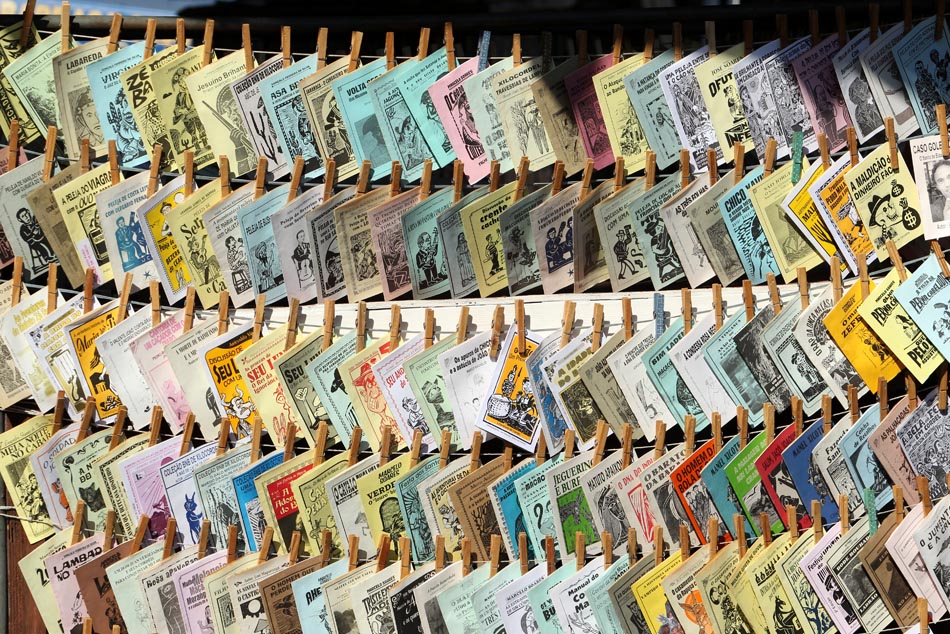
If you come to visit us in Brazil, you’ll occasionally see a stand where the offerings look like this:


Literatura de Cordel (lit. “cord literature”) derives its name from the way the wares are often displayed, i.e. hung by a cord, usually with the aid of clothespins.


Such stands are less common in the southern part of the country, but are a feature in many of the fairs and markets of the northeast, principally in the States of Pernambuco, Paraiba and Ceará.


These little booklets are the last survivors of a form of popular literature with which an inhabitant of eighteenth-century Madrid, or nineteenth-century England, would have been quite familiar, but that you’d be hard-put to find elsewhere in the modern world. They contain stories and ballads and are generally produced in black-and-white, illustrated with woodcuts.


Down through the years, the content has taken-on a distinctly Brazilian flavor.


Many of the books deal with the folklore, legends and history of the northeast, subjects like Lampião and his band.

I've previously written about him under the title The Bandit King. And, if you like, you can read that post by going here:


One of the classics of cord literature, The Arrival of Lampião in Hell, by José Pacheco, is much-prized by collectors.


And a satire on the Brazil’s former president, The Arrival of Lula in Hell has enjoyed a good deal of success.

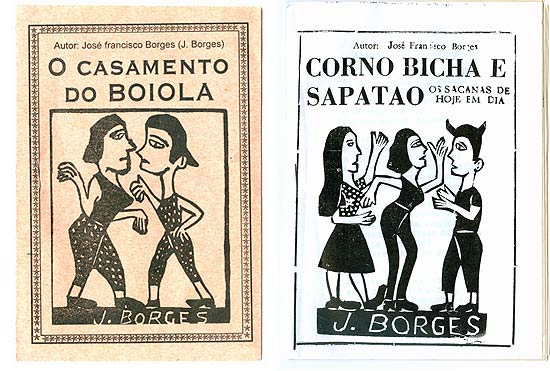
As to the art, two of the more talented woodcutters are Adir Botelho and José Francisco Borges.

This is Botelho:


And this is a work from Borges, who has had expositions at both the Louvre and the Smithsonian:


Monday, February 29, 2016

Make Every Word Count


One of my early writing instructors stressed the need to make every word count. He said each word needs to pull its own weight and every unnecessary word should be culled from the plot. Good advice that I've followed over the years, although, coupled with my journalism training, I'm sometimes too brief, leaving out desirable descriptions.

I've found that writers need to engage readers, not simply enlighten and entertain them. Creating strong word images that readers can relate to is preferable to forcing them to fill in the blanks. For example, a military Hummer conveys a much stronger image than having a protagonist ride to the rescue in a Volkswagen bug. Sue Grafton's Kinsey Millhone was a notable exception..

Strong verbs are necessary to give one’s plot a dynamic, energetic tone. Words such as hurried, leaped and flew as opposed to passive words like walked fast, made his way or became airborne. And as we’ve all been told, stay away from the verb to be in all its forms because it’s the weakest of words. But I confess that I still use all forms of to be in dialogue. Some rules are made to be broken, often at your own risk.

Adverbs that end in –ly also weaken a writer's prose. Use them sparingly. On the other hand, strong specific verbs give writing vitality. I’m reminded of my interview with A.B. Guthrie, Jr. who said, “The adjective is the enemy of the noun and the adverb is the enemy of damn near everything else. Writers use too many descriptive words." As for adjectives, author Lois J. Peterson once said, “One well-chosen adjective can be more effective than two or more, which used together might weaken the idea or image.” I agree.

Do we really need adverbs? Not unless it's impossible to come up with strong verbs. Eliminate the adverbs in a second draft and replace them with muscular verbs. As for adjectives, the rundown house can be rewritten as a hovel or shack. A good reason for every writer to have access to a thesaurus, including an electronic one.

Word choices affect the plot’s pace. If every symphony movement maintained the same pace, the audience would fall asleep before the finale. So writers need to think of themselves as conductors, controlling the pace with word choices, syntax and variety. Long sentences and paragraphs slow the pace and seem introspective while short, choppy sentences are much more dramatic and conducive to action scenes. So, in order to keep someone reading, sentences and paragraphs should vary in length.

Sentence rhythm is important, so reading one's work aloud before committing it to a final draft can prevent clumsy sentence structure. Some word choices bring a sentence to an abrupt halt and should be rewritten or replaced, along with all unnecessary words. The musical analogy is a good one (not my own) because sentence flow is so important.

Thursday, February 4, 2016

Plotting Your Mystery

A strong opening sentence is obviously the best way to pull your reader into the story:

~Today is the last day of my life.

~The body was hanging at eye level.

~ The snow was so deep that only his cap was visible.

I know that you can write better opening sentences to entice your reader into your fictional world. It’s a writer’s job to seduce and lure, one carefully crafted step at a time into an adventure away from reality.

The reader needs to know where you’re taking her and why. Is your fictional world believable? Fantasy writers can get away with great stretches of the imagination but mystery writers need to stick to the facts. So don’t have a body suspended in mid-air unless you have a logical reason to do so.

Your opening sentence should lead directly into your main theme. Don’t start with a couple kissing on a park bench unless one or both are shot or witness to a nearby killing. And don’t start with boring backstory or you’ll soon lose your reader. Jump immediately into the action. Keep your reader breathless for pages before you let him up for air.

Motivation and goals are essential in developing your plot. Another good way to lose your reader is to have your protagonist risk his life simply because he had his foot stepped on. If the killer murdered the character’s mother, you have a believable reason for him to go after the culprit. Some amateur sleuth stories border on the ridiculous when ordinary people decide to trap a killer simply because they think they can. Give them good reasons to place their own lives in danger.

Don’t people your plots with too many characters. Mark Twain wrote that the best way to get rid of characters when they’re no longer needed is to have them jump down a well. Better yet, make sure characters are only there to further the plot and can be eliminated when you tie up all the story’s loose ends.

Killing off characters can be painful for the writer but extraneous side plots can kill a story. In the old western films cowboys rode off into the sunset with the townspeople staring after them. Not so with mystery novels, no matter what the sub genre. We want to leave the reader wanting more. Readers like to solve the mystery on their own before the conclusion, so don’t make the killer’s identity the most unlikely candidate in your plot. Be fair when you plant red herrings and clues so that the reader will be able say, “Aha, I should have known it was him (or her).”

What’s the best opening sentence you’ve written or read?

Tuesday, January 19, 2016

Writing for Older Readers


I write senior sleuth novels because there’s a growing market for retirees who enjoy  reading about characters in their own age group. I was intrigued years ago by Miss Marple and Hercule Poirot, who were wise and introspective, but never seemed to have any fun.

That’s not true of today’s seniors who are less inclined to retire to their rocking chairs than previous generations.

The late Pat Browning, who wrote Absinthe of Malice, said: “A St. Martin's editor gave me a piece of advice I have never forgotten: ‘Be careful not to turn your characters into cartoons.’ I try to picture older characters as they are--the same people they always were, only older. This is especially true when it comes to romance and sex. For all the jokes about senior sex, it's a very real part of senior life, and it's no joke to those lucky enough to have a romantic partner late in life.”

I agree. Not unlike Janet Evanovich’s character, Grandma Mazur, who is eccentric enough for a cartoon character, most seniors have the same interests they’ve always had, with the possible exception of roller blading and downhill skiing. On second thought, I once interviewed Buffalo Bill’s grandson Bill Cody, who learned to downhill ski at 65 to keep up with his much younger wife.

Mike Befeler writes what he calls “Geezer-lit.” His novels feature his octogenarian protagonist, “who is short on memory but has a sense of humor and love of life. He accepts his ‘geezerhood,’ solves a mystery and enjoys romance along the way.”

My second senior sleuth mystery, A Village Shattered, takes place in a California retirement village. The plot is generously sprinkled with humor but none of the seniors resemble cartoon characters, although a couple come close with a redneck Casanova and love starved widow. Diary of Murder followed and I portrayed the two 60-year-old protagonist widows as quite capable of traveling the country in their motorhome as well as chasing down killers who happened to be drug dealers. 

Another senior writer, Beth Solheim, spent years working in a nursing home and says she loves the elderly and their “humorous, quirky insight to life, love and longevity.”

Chester Campbell, an octogenarian, writes the Greg McKenzie Mysteries. He said, “My friends in this [age] bracket are out going places and doing things. Some, like me, continue to work at jobs they enjoy. I chose to use a senior couple in my books who are long married, get along fine, and do a competent job as private investigators. Greg, who narrates the books, is aware of his limitations from age and makes up for physical shortcomings by outsmarting his adversaries. My hope is to dispel some of the absurdity of the stereotypes about seniors that are all too familiar. Like the old song says, "Anything you can do I can do better."

Like so many other novelists, I write what I enjoy reading. My readers are mainly retirees and baby boomers who number over 78 million. Some 8,000 boomers are moving into the senior column every day, the fastest growing potential book buying market on record.

We’re experiencing the graying of America. What better subgenre to write about?

Friday, January 1, 2016

Happy New Year!

January First has traditionally been a day of renewal and promises to oneself to do better in the coming year, so resolutions are made and usually kept for a few days to perhaps an entire month before we fall back into our old ways.

The top resolutions are usually the following: 

Weight loss: Losing weight comprises the most resolutions for Americans. Over a third of the population resolves to exercise more and stay healthy. A weight loss program is easy to start but if you don't find one you can live with, you'll fall off the wagon before the wheels gather dust. Nutritionists say to eat less and switch to healthier food such as the Mediterranean diet.  It's not easy to give up junk food, especially sugar laden sweets. But with determination and some basic tips you can slowly develop healthier eating habits. Learn to control emotional eating, be aware of reasons why diets fail, and research healthy recipes.

Improving  concentration and mental skills: There are plenty of supplements on the market that claim to make you smarter, but do they really work? Experts say that most improve memory although they don't actually raise your I.Q.  Some meditation techniques such as TM (Transcendental Meditation) are known to recharge one's batteries, and reading a good book instead of watching mind-numbing TV programs has been proven to help prevent frontal brain shrinkage and dementia. Cross word puzzles and other mind games are also good sources of improving concentration and mental skills.

Improving social skills:  When we stay at home and don't make the effort to meet people, we  miss out on opportunities to make new friends and enjoy life more. Networking can improve one's well-being and career, so we  need to overcome shyness, acquire knowledge as well met interesting people. 

Gaining confident and taking chances: If you're confident, others notice and are more likely to listen to what you have to say, so bone up on subjects that interest others, including current events. Make sure you're knowledgeable when you express your opinions. A good dose of self-confidence will help you lead a much happier life.

Earn more money: Even the wealthy search for ways to earn more money, and those of us climbing the financial ladder can always use an additional source of income to make life more enjoyable. Fortunately there are options available, such as a second job, taking employment courses, freelancing or using the Internet to your advantage.

Become more Tactful: Good manners have always been important although they don't seem to be practiced as much by the younger generations. Politeness makes it easier to connect with others, avoid offending people and ensures that others perceive you as a good and trustworthy person. So learn etiquette and deal with rude people the right way, as well as learning how to say no without offending.

Reducing stress: Stress kills and it can ruin relationships as well as your health. Stress may be an unavoidable side effect of modern life, but it can be effectively managed with the help of a good stress management course.

Happier with life: Even those who are in good physical shape, earn a decent living and have stress under control can be unhappy. Happiness requires time and patience to learn how to find joy in small things and prevent problems from getting you down. The right partner can also contribute to a happier life.

More sleep  It can be difficult to get sufficient sleep with a TV in the bedroom as well as computers, smart phones, tablets and gadgets with glowing lights and beeping alarms. We need 7-8 of sleep to function well enough to get through the day, and avoiding electronic devises in the bedroom is a good start. Avoiding sweets before bedtime is also a good practice.

Other traditional resolutions are to stop smoking, stop drinking or doing drugs, control one's temper, become more loving and kind to others, and stop beating yourself up over trivial matters. Whatever your resolutions happen to be, I wish you more self-discipline and self-control in the coming year as well as successes and happiness.
Happy New Year!!!